
Cache County Three-Day Release Gap
No official Cache County 72-hour release feed was found. The Sheriff’s Jail Division page describes a current-inmate list and a separate “Who’s been booked? (Last 30 days)” list, but both were unavailable on the research date. Neither is labeled as a recent-release view. The first is about current custody. The second uses an admission window, not a departure window. Filtering a booking date to three days would not turn it into a release record.
The official substitute is a date-range inquiry. For a broad three-day lookback, identify the start and end timestamps and ask Sheriff Records for jail releases or departures within that span. Request release disposition and receiving authority where releasable. If the inquiry concerns one person, add full name, date of birth, aliases, and booking number when known. A narrow request reduces ambiguity and separates one jail stay from another.
Request Cache County 72-Hour Records
A useful three-day request defines time, people, and the event sought. “Everyone released this weekend” can be unclear if the weekend crosses a holiday, if a person was transferred, or if the office reads “released” as community release only. Use “departures from physical Cache County Jail custody” and ask for the disposition and destination. That phrasing captures both community exits and custodial handoffs without treating them as the same outcome.
- Choose exact beginning and ending timestamps, including the local dates and times for the full period at issue.
- Check the jail page for an outage notice, but do not substitute either online display for a release window.
- Call (435) 755-1227 if one person’s present location is urgent. Ask whether the person remains physically held.
- Download the Cache County Request for Records form and select the Jail Records category.
- State the exact range and request actual departure time, disposition, destination or receiving agency, booking number, charges, and court identifiers where maintained and releasable.
- Email the completed remote request and identity or notarization material, when required, to recordsrequest@cachesheriff.gov.
The same-day Released Last 24 Hours check is faster when the question is whether one known person got out today. The three-day method is built for a wider span and for events that may cross business-day boundaries.
Cache County 72-Hour Record Fields
Because there is no verified online release list, Cache County has no published set of 72-hour feed columns. The Records form confirms that jail records may be requested, yet it does not promise a fixed field set. Ask for each useful item. Disclosure still depends on whether the Sheriff maintains the field and whether Utah records law permits its release.
| Requested field | Use in a three-day review |
|---|---|
| Name, aliases, date of birth | Matches the departure to the right person. |
| Booking number | Separates repeated stays and similar names. |
| Admission and actual departure time | Places the custody event inside or outside the exact range. |
| Release type or disposition | Distinguishes bond, dismissal, time served, sentence completion, and transfer. |
| Destination or receiving authority | Shows whether the departure led to community release or continued custody. |
| Holds, court and case identifiers | Points to the authority that may explain the result. |
These fields answer different questions. The court case can show an order, sentence, dismissal, or credit for time served, while the jail departure timestamp shows when physical custody ended. A bond receipt proves payment but not exit. A receiving-agency field can reveal that Cache County custody ended while another form of custody began.
Note: Request redacted or segregable portions when needed so a restricted detail does not block access to releasable departure information.
Cache County Weekend Release Windows
A three-day period is useful around weekends because an inquiry made on Monday may concern events from Friday through Sunday. Cache County does not publish a weekend or holiday release schedule, a standard exit time, or a rule that shifts departures to a business day. Do not borrow Tuesday state-prison release procedures for ordinary county detainees. UDC’s process applies to state prisoners, not to a person leaving Cache County Jail after a local bond or court event.
Set the requested start and end times wide enough to cover the real question. If a holiday is involved, name it and include the dates on both sides. Records office processing time is separate from the jail event itself. A person can depart during the requested span even though a written response arrives later. For urgent welfare or pickup planning, call the jail for current physical status and use the written request as the follow-up record.
The Sheriff’s published administrative account-window hours are not release hours, and the published Records hours are not a jail-exit schedule. Confirm any planned visit before traveling. No source supports a claim that a person will leave at a set time merely because bond was paid or a court order was entered.
Cache County Booking-List Mismatch
Cache County’s online architecture creates an easy mistake. A rolling 30-day booking list groups people who entered the jail during an admission window. It does not identify all people who departed during the last three days. Someone booked earlier than the displayed window could leave now, while a person booked yesterday could remain in custody. The direct historical endpoint was also unavailable, so its live fields and any post-release status cannot be assumed.
The Sheriff’s online-information terms add another limit. The unofficial roster is not updated more often than six times per hour and often updates less frequently. This caps update frequency. It does not promise a fixed refresh, define release-field lag, or establish online retention. The Records Department’s statement that most agency records stay on file for five years and some indefinitely also does not mean a roster entry remains online for five years.
The source capture below preserves the local cadence and official-record warning that governs both unavailable displays.
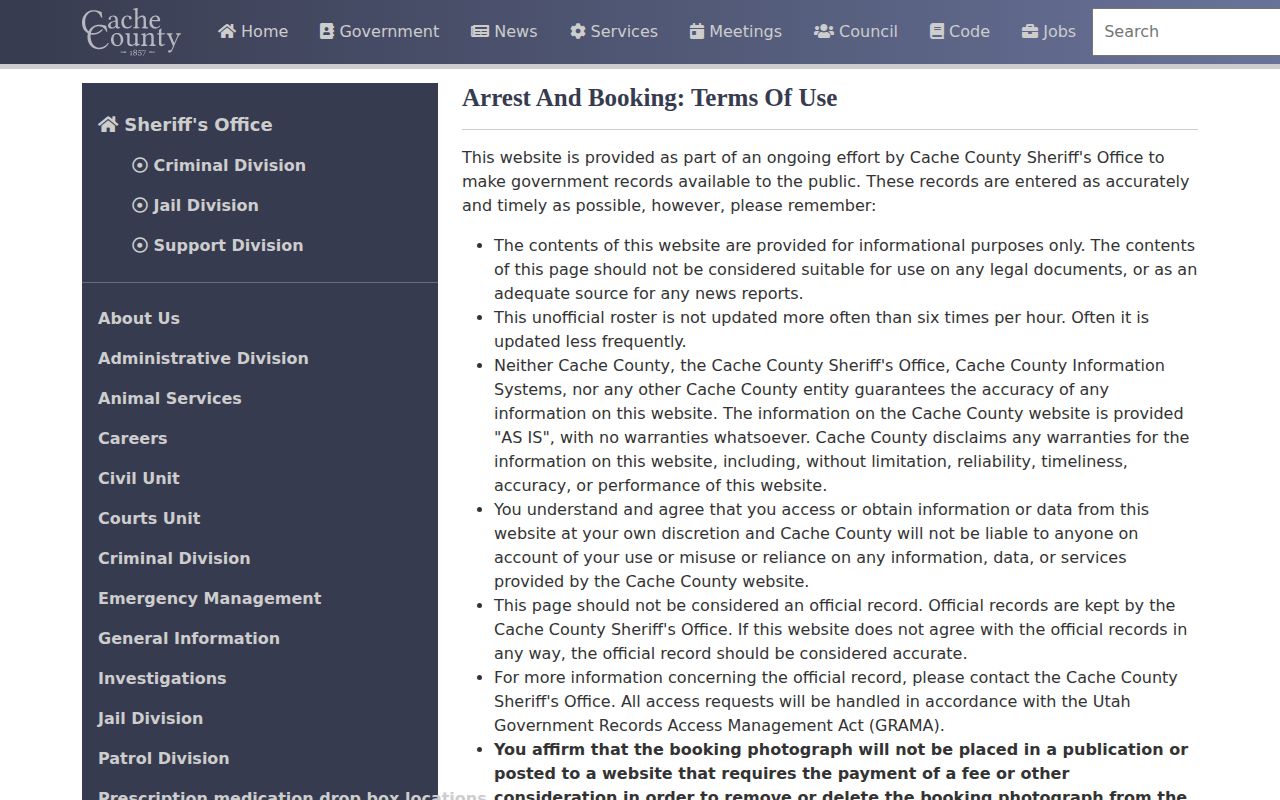
That combination makes an exact records request the sound way to reconstruct a 72-hour period. It avoids treating admissions as departures and avoids using a changing display as a durable history.
Trace Cache County Transfer Departures
Each departure in the three-day span needs an outcome. A local detainee may leave for the community after bond, a court release, dismissal, time served, or sentence completion. Another entry may reflect transfer to UDC, a different county, federal authorities, medical custody, or ICE. “Released from Cache County” describes the end of Cache physical custody, not necessarily the end of all custody.
| Recorded path | Next verification source |
|---|---|
| Community release | Cache jail departure record and, where relevant, the court disposition. |
| Utah state custody or supervision | UDC offender search, Board order, or UDC records request. |
| Federal custody | BOP locator for sentenced prisoners; USMS inquiry for Marshals custody. |
| ICE handoff | ICE Online Detainee Locator and direct ICE verification. |
| Another county | The receiving sheriff or jail. |
The public Cache roster specifically excludes Utah State and federal inmates housed at the jail. Nonappearance can therefore mean contract custody, not release. Establish legal custody before choosing the next locator. For a full named-person path across all systems, the Cache County release search explains how county, state, court, notification, federal, and immigration records fit together.
Cache County Release Request Timing
Cache County Records accepts requests by email or in person at the Sheriff complex. The Records Department page publishes office hours of 8:00 a.m. to 4:30 p.m., but does not expressly state weekdays, so confirm before visiting. It says processing occurs as soon as reasonably possible and may take up to ten working days. Active reports remain unavailable until cleared. Those time limits make the process a documentation channel, not an instant online three-day feed.
The published form prices jail records at $10 per 25 pages, prorated. Inspection can be free by appointment when it can be completed in a reasonable time, and the record cannot leave or be copied during that inspection. Cache County accepts cash, credit card, or money order and does not accept personal checks. Ask for a cost estimate if the date-range request may produce many records.
GRAMA, Utah’s Government Records Access and Management Act, governs the request process and permits classification or redaction of private, controlled, or protected material. Ask for the public portions that identify the departure event. A record completed but not picked up within 60 days is destroyed without refund under the Sheriff’s published procedure, so watch for the response and retrieval instructions.
Note: A records response may arrive after the three-day window closes, but its departure timestamps preserve the period more reliably than a live page.
Verify Cache County Release Results
Read the final record as a chain of custody. Confirm the person, booking event, departure time, disposition, and destination. If the destination names another authority, use that authority’s source. The UDC search covers people currently under Utah corrections supervision, not every former county detainee or every fully discharged person. VINELink can provide custody-event alerts where coverage applies, but it is not a certified historical list. A court record can explain legal authority without proving the precise physical exit.
A no-result search stays inconclusive until those scope limits are checked. The person may be listed under an alias, outside the requested date range, in another county, in contract custody that Cache’s roster excludes, or subject to a sealed or restricted record. Conversely, an old booking entry does not establish present custody. The three-day method works because it asks the Sheriff for the event itself and then follows the destination rather than trying to infer release from a changing screen.