
Cache County VINELink Release Coverage
Utah calls its statewide program the UDC VINE Service. The Utah Department of Corrections supports checks by an inmate's name or offender number through VINELink and by phone at 1-877-884-8463. The service is free and runs at all times. UDC says callers can learn whether a person is in custody and whether a release date exists. That makes VINE useful for a specific Cache County person who is legally in UDC custody, including a state prisoner housed in a county contract bed.
Cache County Jail participation needs more care. No accessible official list confirmed that the independent county jail sends all of its events into VINE. A Cache-only detainee may appear when the live Utah search is checked, but that possibility is not a promise of coverage. When no match appears, call the jail at (435) 755-1227 and ask if the person is physically held, has departed, or was handed to another agency. The jail record is the durable source for an ordinary county release.
Legal custody controls the answer even when the person is physically inside the same building. Cache County's public roster excludes Utah State and federal prisoners housed in its jail. A state prisoner in a Cache contract bed can therefore be absent from the county display while remaining within UDC's notification scope. An ordinary Cache detainee released on bond, by court order, after time served, or at the end of a county sentence remains a Sheriff matter. Identify that custodial track before treating any VINE result as complete.
Coverage limit: UDC VINE coverage is documented. Complete Cache County Jail participation is not, so a missing result cannot establish release.
Search Cache County VINELink Records
Begin with one person and the system most likely to hold that person. A correct jurisdiction prevents a false no-result. VINELink is a status and notification tool, not a broad archive of every former Cache County detainee. Use enough identifying detail to separate people who share a name, and treat a transfer event as a change of custodian rather than proof of community release.
- Open VINELink and choose Utah. The phone route is also available at 1-877-884-8463, with a live operator in English or Spanish.
- Search by the person's full name or UDC offender number. An offender number is the strongest match when it is known.
- Compare the identifiers and custody details shown for each result. Do not select a record based on name alone.
- Open the matched record and read the custody status and any release-date information. Keep release, transfer, and community-correctional-center events distinct.
- If the person is not found, contact Cache County Jail or search the UDC offender interface according to the known custody path.
The broader Cache County released-inmate search path explains how Sheriff records, UDC, court files, BOP, and ICE fit together when VINE alone cannot settle the question. An old county event is especially likely to require a written Sheriff record because VINE is not a certified historical archive.
A court record can explain the legal reason for release without proving the time a person crossed the jail door. In Cache County, felony and class A misdemeanor cases generally route through the First Judicial District, while other matters may belong to a municipal justice court. Search the correct court when an order, dismissal, sentence, or warrant could explain the event, then pair that entry with the jail's actual departure record from the Sheriff Records Department.
Note: A released person may leave a live roster or current-supervision search, so preserve the agency record when lasting proof is needed.
Cache County VINELink Release Fields
UDC's static material supports only a careful field description. It says VINE reports custody status and whether a release date exists. The exact labels on a current Utah released-result card were not verified in the official written sources, so labels should be read from the live record instead of assumed. The matched record may also support notification registration for later events.
| Information | How to read it |
|---|---|
| Name or offender number | Use it to match the right person. Compare all available identifiers before relying on the result. |
| Custody status | Shows the status reported by the participating agency. Confirm it with that agency when timing matters. |
| Release-date information | May show whether a date exists. It is not a promise that no later hold, transfer, or order will affect departure. |
| Custody-change event | Release, transfer, escape, and death are distinct events. A transfer is not community release. |
| Notification option | Allows registration for alerts tied to the matched record through phone or email. |
The UDC offender search supplies a separate set of fields for identity, location, facility, release date and type, and case-manager details. A location of PAROLE or PROBATION indicates community supervision. Those UDC fields must not be attributed to VINELink, and a county-jail release must not be replaced by a state record.
UDC also warns that its offender search covers only people currently under its supervision. A former state prisoner who has fully discharged may no longer appear. In that case, a UDC records request and the Board decision may preserve the final status more reliably than a current public search. VINE still serves notice, but it should not be stretched into a complete state custody history.
Register Cache County Release Alerts
Registration starts only after the correct person is matched. Utah permits phone or email notification. The choice affects how acknowledgment works. Phone registration uses a personal identification number, or PIN, while email sends one message for the event. Registrations are anonymous, and several phone numbers may use the same PIN.
- Select the notification option on the matched VINELink record.
- Choose phone or email and enter the number or address that should receive the alert.
- For phone alerts, create the PIN requested by VINE and retain it in a safe place.
- When a call arrives, listen to the event and enter the correct PIN to confirm receipt.
- Verify the event with UDC or Cache County Jail. Ask whether it was a release, transfer, or other custody change.
A VINE alert gives fast notice, but it does not supply a certified release record. For a county event, ask the Sheriff for the actual departure date and time, release disposition, and receiving authority. For state custody, review UDC and any Board order. Those records show who ended custody and what came next.
Utah VINE Call Confirmation
Utah's repeat-call process is the distinctive local layer. The UDC victim-notification rules say VINE calls every hour for as long as 48 hours until the recipient enters the correct PIN. If a call is not answered, the system leaves a message and tries again within two hours. Email notice is sent once. The PIN confirms that the notice was received; it does not change the person's custody status.
The range of UDC events is broad. Notice may concern release, transfer, escape, or death. Utah also supplies notice 30 days before a parole release and reports moves to county jails, between state prison sites, and to a community correctional center. A move to such a center remains a custody or supervision event. It should not be described as an ordinary Cache County jail release to the community.
The official notification page is visible in the captured source below. Its state-level scope is why the Cache-only caveat remains necessary.
Review Utah's official VINE notification instructions before choosing an alert method.
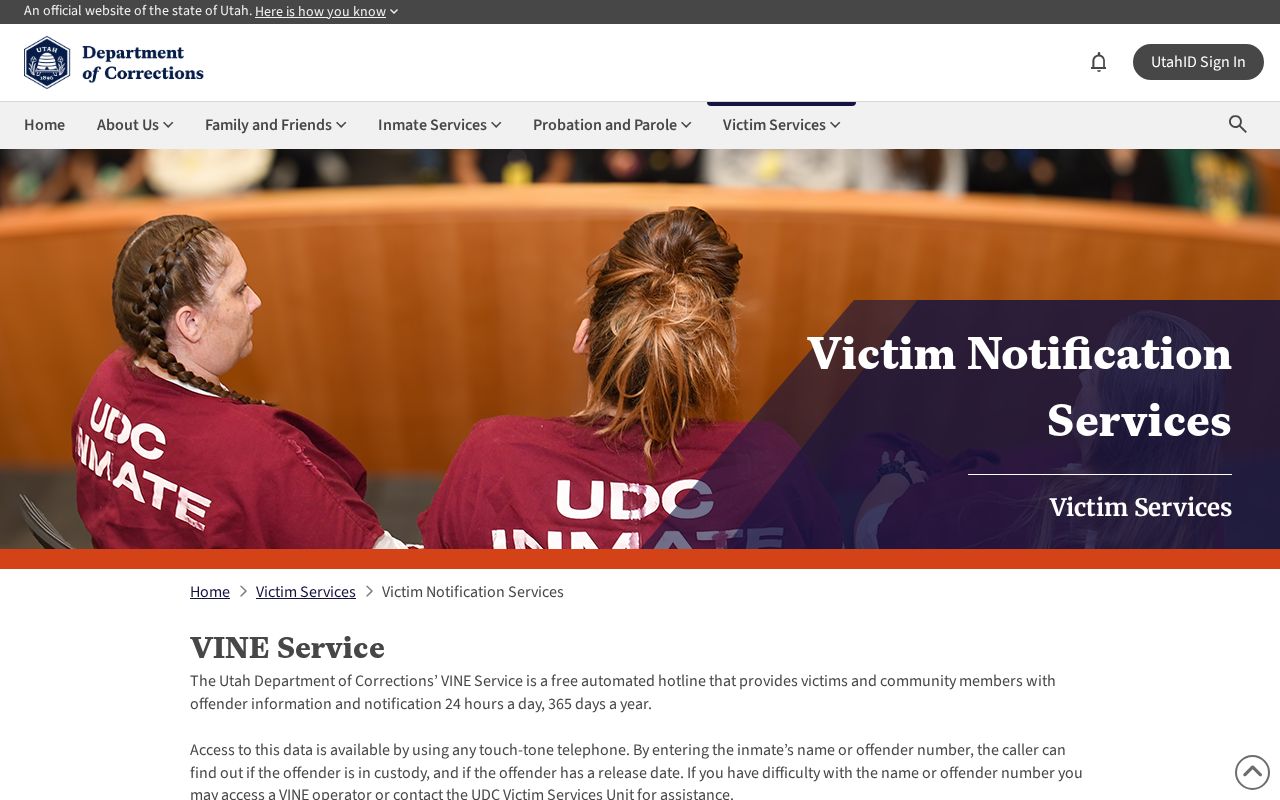
The source confirms the UDC notification layer, repeat calls, and PIN process, but it does not certify every Cache County Jail event.
Verify Cache County Release Events
Match the follow-up agency to the event. For an ordinary Cache detainee, call the jail and then request the Sheriff booking and release record. For a Utah prisoner or parolee, use UDC's offender search and the Utah Board of Pardons and Parole decision when a parole date is involved. A Board hearing date is not a release date, and even an ordered future parole date can change before departure.
Federal and immigration custody sit outside Utah VINE. A sentenced federal prisoner is searched through the Bureau of Prisons locator. ICE's detainee locator covers current ICE custody and some releases from ICE within the prior 60 days. A Cache release to ICE means that Cache custody ended, not that the person entered the community. U.S. Marshals custody may require a focused agency inquiry because there is no matching public historical locator.
- Release
- The reporting agency ended its custody. Another hold or supervision term may still follow.
- Transfer
- One custodian handed the person to another facility or authority.
- Parole
- State-prison release into community supervision while the sentence continues.
- Discharge
- Supervision or custody has ended under the controlling agency's record.
Note: Agency records can post after the physical event, so compare the alert time with the official departure record.
VINELink Limits for Cache Releases
Three limits matter most. First, a missing Cache County result is inconclusive because county participation was not confirmed. Second, a VINE event can lag the physical change and may describe a transfer rather than a release. Third, VINE does not replace the federal BOP or ICE tools. The safest result comes from pairing notice with the record of the agency that actually held the person.
Identity errors also matter. Similar names, aliases, and incomplete identifiers can point to the wrong record. Search by offender number when possible and compare every detail the live result provides. If a result conflicts with the Sheriff, UDC, or a court order, ask the originating agency to explain or correct its record.
Use VINELink for timely notice and a focused status check. Use the Cache Sheriff release record for a local departure, UDC and Board records for state custody, and the correct federal system for a federal handoff. That division keeps one alert from being stretched beyond what it can prove.